


Are you looking for an English-speaking dog trainer in Toulouse who can help you train your puppy or improve your adult dog’s behaviour?
Perhaps you have recently moved to France with your dog, adopted a puppy in the Toulouse area, or simply want professional guidance without having to struggle with French technical terms.
My name is Nicolas Lasfargues, and I have been working as a professional dog trainer in the Toulouse area since 2006.
I offer private, one-to-one dog training lessons at my enclosed training ground in Tournefeuille, just west of Toulouse. My approach is based on positive reinforcement, rewards and clear communication between dogs and their owners.
Having spent part of my childhood in California, I am fluent in both English and French, so I can explain every exercise and answer your questions in English.
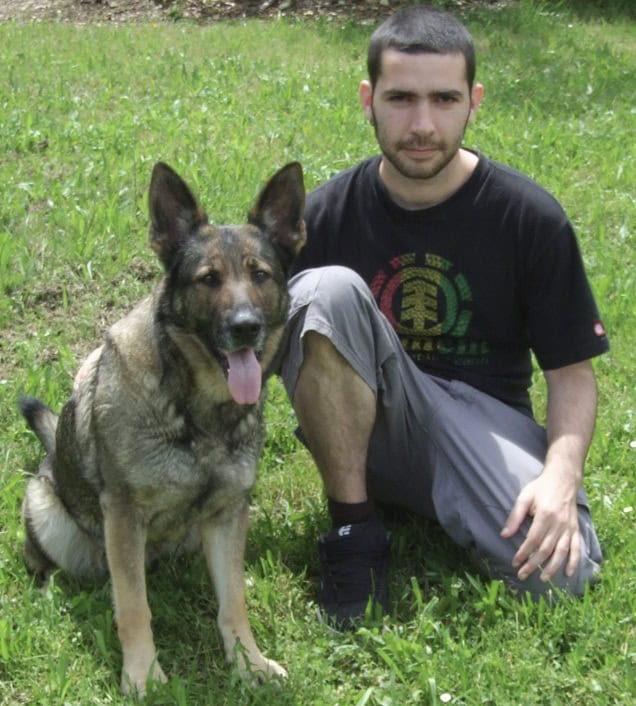
Whether you have a young puppy, an energetic adolescent dog or an adult companion with established habits, my aim is to help you build a calmer, more enjoyable relationship with your dog.
1. Why choose an English-speaking dog trainer in Toulouse?
Moving to another country can be challenging, especially when you have a dog to look after.
You may need to understand local regulations, find a veterinarian or adapt your dog’s routine to a new home and unfamiliar surroundings.
If you are also dealing with training difficulties, being able to communicate clearly with your dog trainer can make a real difference.
I spent four years of my childhood in California, including time in the Los Angeles area. This experience helped me become fluent in English, a language I continue to enjoy speaking today.
Over the years, I have welcomed English-speaking dog owners living in Toulouse and the surrounding towns, including expatriates working for Airbus and other international companies.
During our lessons, we can discuss your dog’s behaviour, training exercises and progress entirely in English.
This is particularly useful when we need to discuss subtle differences between excitement, fear, frustration or a lack of understanding.
Of course, your dog does not need to understand English!
Dogs learn to associate consistent words, gestures and situations with particular behaviours. What matters most is that you and your family understand how to teach those behaviours correctly.
I can therefore help you choose simple, consistent commands, whether you prefer to use English or French.
You can also read more about my background and experience as a dog trainer (in French).
2. What can I help your puppy or adult dog learn?
Every dog is different, and training should reflect its age, temperament, previous experiences and daily environment.
Some owners contact me because they have just welcomed a puppy. Others have lived with their dog for several years but would like to improve particular behaviours.
Puppy training in Toulouse
The first few months are an important period for developing good habits.
I can help you work on:
- House training: teaching your puppy where and when to relieve itself.
- Recall: encouraging your puppy to come back when called.
- Loose-lead walking: learning to walk without constantly pulling.
- Biting and mouthing: redirecting puppy biting towards appropriate toys and activities.
- Jumping up: rewarding calmer ways of greeting people.
- Socialisation: introducing new people, dogs and environments gradually and positively.
- Being left alone: helping your puppy become comfortable with short separations.
- Basic cues: sit, down, stay and other useful everyday skills.
Training should begin with simple, enjoyable exercises suited to your puppy’s development.
I generally introduce more structured obedience lessons from around three months of age, although you can start teaching good habits at home as soon as your puppy arrives.
You are also welcome to contact me earlier for advice.
Training for adolescent and adult dogs
It is never too late for a dog to learn new skills.
I regularly work with adult dogs whose owners would like to improve their everyday behaviour.
Common difficulties include:
- Pulling on the lead during walks.
- Ignoring recall commands.
- Jumping on visitors.
- Becoming overexcited around other dogs.
- Barking excessively in certain situations.
- Having difficulty settling down at home.
- Reacting fearfully or becoming frustrated around unfamiliar people or dogs.
With adult dogs, we often need to understand why a behaviour occurs before deciding how to change it.
Some difficulties can be improved through straightforward training exercises. Others require a more gradual approach, changes to the dog’s environment or professional veterinary advice.
My first objective is always to assess the situation and propose realistic steps adapted to your dog.
3. How does positive reinforcement dog training work?
I believe that dogs learn best when they understand what we want them to do and have a good reason to do it.
That is why I use positive reinforcement training, which focuses on rewarding desirable behaviours rather than relying on intimidation or painful corrections.
A reward might be:
- A small, tasty treat.
- A favourite toy.
- A short game.
- Praise or gentle attention, when the dog enjoys it.
- Access to an activity the dog particularly likes.
For example, imagine that your dog tends to jump up whenever visitors arrive.
Rather than simply punishing the jumping, we can teach the dog that keeping all four paws on the floor leads to something pleasant.
With practice, the calmer behaviour becomes easier to repeat.
Training based on rewards, not fear
Reward-based training is recommended by several recognised animal welfare organisations.
The British charity Dogs Trust explains positive reinforcement training, including how food, toys and attention can help dogs learn everyday skills.
The American Veterinary Society of Animal Behavior (AVSAB) also recommends reward-based methods for dog training and behaviour modification, while warning against aversive techniques that can compromise animal welfare.
These principles are consistent with my own approach.
I want dogs to understand the exercises, participate willingly and develop confidence in their owners.
This does not mean allowing a dog to do whatever it wants. Clear rules, consistency and regular practice are still essential.
It means teaching those rules in a way the dog can understand, without resorting to fear or force.
My experience with clicker training
I have also trained with Catherine Collignon, founder of the Centre Animalin in France and an important figure in the development of positive dog training.
This training introduced me to more precise ways of rewarding desirable behaviour, including the use of a clicker.
A clicker is a small device that produces a brief, recognisable sound. Once the dog has learned its meaning, the sound can mark the exact moment it performs a desired behaviour.
I sometimes use this technique during my lessons, depending on the dog and the exercise.
However, a clicker is not compulsory: effective reward-based training can also be achieved with a consistent verbal marker.
4. Why choose private dog training instead of group classes?
Many dog owners wonder whether they should join a local dog training club or book individual lessons.
Both options can be useful, but they do not always serve the same purpose.
In a group class, several dogs learn in the same environment. This can be enjoyable and provide opportunities to practise around distractions.
However, some dogs find these conditions challenging.
A young puppy may be more interested in playing with other dogs than listening to its owner. A nervous dog may feel uncomfortable in a busy group, while an excitable dog may struggle to concentrate.
Private dog training allows me to adapt the lesson entirely to you and your dog.
This means that I can:
- Adjust each exercise to your dog’s abilities.
- Progress at a pace that suits your dog.
- Work on the particular difficulties you experience.
- Introduce distractions gradually.
- Give you individual feedback throughout the session.
- Involve other members of your family in the training.
Your participation is especially important.
I do not simply train your dog while you watch. I demonstrate the exercises and then help you practise them yourself.
My goal is for you to feel confident repeating the exercises at home and on your regular walks.
What about socialisation with other dogs?
Private lessons do not mean your dog will never meet other dogs.
When appropriate, I can involve my own dogs in carefully managed exercises.
We may practise walking past another dog calmly, maintaining attention in the presence of a dog or introducing controlled interactions.
The objective is not to force dogs to play together, but to help them feel comfortable and behave appropriately around one another.
Group classes and dog sports can also be valuable later, once your dog has developed the necessary skills.
5. Where are my dog training lessons held near Toulouse?
Most of my lessons take place at my private training ground in Tournefeuille, on the western side of Toulouse.
The address is:
8 impasse du Grillou, 31170 Tournefeuille, France
The training area is located near the La Ramée leisure park.
It is easily accessible from several parts of the Toulouse metropolitan area, including Colomiers, Cugnaux, Plaisance-du-Touch, Blagnac and La Salvetat-Saint-Gilles.
My training ground is private and enclosed, allowing us to work in a controlled environment.
It also includes a sheltered area where we can continue lessons when the weather is rainy or particularly sunny.
This setting is especially useful for teaching basic obedience, recall and loose-lead walking.
We can start with relatively few distractions and gradually make the exercises more challenging as your dog progresses.
The training ground also gives us opportunities to organise carefully controlled encounters with other dogs, when appropriate.
You are welcome to bring family members who are involved in your dog’s daily care.
Consistent communication between everyone in the household can make training easier and more effective.
Whether you live in central Toulouse, near the Airbus facilities in Blagnac or in one of the surrounding towns, you can arrange an appointment to visit my training ground.
6. Can I book dog training lessons at home?
Although I usually recommend lessons at my training ground, I can also offer home visits in certain circumstances.
Some owners have difficulty travelling, while others have dogs that become particularly stressed in the car.
Certain behaviour problems are also easier to observe in the dog’s everyday environment.
For example, home training may be useful when a dog:
- Becomes overexcited when visitors arrive.
- Barks repeatedly at sounds outside the house.
- Has difficulty settling down in the family home.
- Struggles with particular routines linked to its environment.
I can arrange home visits in selected areas around Tournefeuille and, depending on availability, near Lavernose-Lacasse and Muret, south of Toulouse.
Whether a home visit is appropriate will depend on your location, your dog’s needs and my schedule.
Travel conditions may apply.
For more detailed information, please see my dog training at home page (in French).
If you are unsure which option would be best, feel free to contact me in English. I will explain what I recommend for your particular situation.
7. How can I book a free first dog training assessment?
If you would like to meet me before booking lessons, I offer a free initial assessment at my training ground in Tournefeuille, with no obligation to continue.
This first meeting gives us an opportunity to get to know each other.
We can discuss your dog’s age, background, habits and any behaviour you would like to improve.
I can also observe how your dog responds to simple situations and explain the methods I use during training.
After this assessment, I can suggest a suitable training programme based on your needs.
How much do private dog training lessons cost?
I offer individual lessons and a training package for owners who would like more structured support.
For up-to-date prices, session details and available packages, please visit my dog training prices page (in French).
If you prefer, I will gladly explain the pricing and available options in English during our first conversation.
Contact Nicolas – Dog trainer in Toulouse
You can contact me directly:
Phone: 06 32 15 00 91
Email: lasfarguesnicolas@gmail.com
You can also use my contact page, where you will find directions to my training ground in Tournefeuille.
Please feel free to write or speak to me in English.
I have been helping dog owners in Toulouse since 2006, and I would be delighted to help you improve communication with your dog.
Whether you have just welcomed a puppy or would like to work on your adult dog’s behaviour, I look forward to meeting you and your four-legged companion.
Nicolas Lasfargues – English-speaking dog trainer in Tournefeuille, Toulouse.


